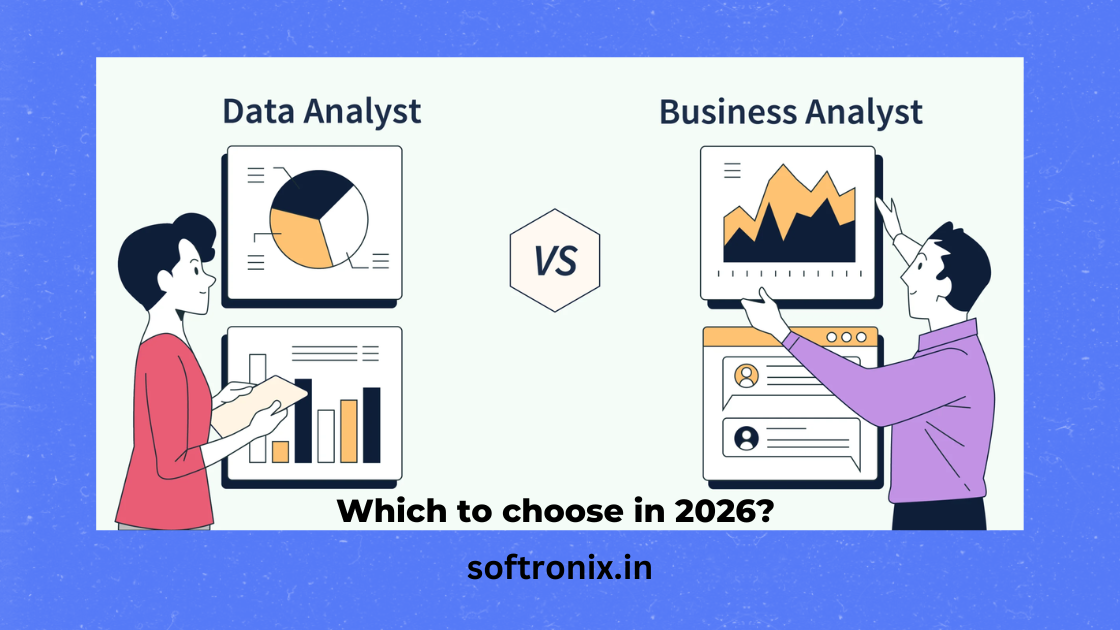
Data Analyst vs Bussiness Analyst: Which to choose in 2026?
If you're planning a career in tech or data, you've probably come across both Business Analyst and Data Analyst roles and wondered what sets them apart. At first glance, they look alike. They're both about data, both used for decision making, and both are in demand. However, give them a few minutes to dig a little deeper and you'll see that these are very different jobs, with different daily routines, different skill sets, and different personalities.
In 2026, as digital transformation is going through all industries, from banking to healthcare, both roles are expanding more than most people thought. The real question isn't which career is better overall. It's which one is the right fit for your skills, interests, and career goals.
Business Analyst Job Description: What It Is and What It Isn't
The Business Analyst serves as a liaison between the business and the technical implementation team creating the solutions. The BA is the individual who, when a company decides to enhance a process, go ahead and launch a new product, or create a software system, determines what the business actually requires and then turns that into something that developers and project teams can develop.
A typical day for a Business Analyst could involve meeting with stakeholders to gather pain points, creating detailed requirement documents, creating a new system map that considers current and future business processes, or reviewing a new system to ensure that it alleviates the right pain point. It's not just about the technical expertise; good communication skills and the right questions are key in this position.
Business Analysts are in demand in various industries such as banking, insurance, IT services, healthcare, e-commerce, consulting, and government projects. You will always have someone with a BA in any organisation that is undergoing any type of transformation, digital or otherwise.
What is The Job of a Data Analyst?
A Data Analyst's job is to turn raw data into patterns, trends and insights that allow the organization to make informed and intelligent decisions. The processes performed in the job are collecting data from multiple sources, cleaning the data, and analyzing the data to give answers to specific business questions.
This could be sales information on a dashboard, a report on churn data, or even one that shows which marketing is working. One of the most important part of the day for Data Analysts is spending part of the day in cleaning and understanding the meaning of dirty data before they can perform interesting data analysis.
There's a demand for Data Analysts in the financial services sector, retail, healthcare, logistics, social media, and manufacturing, as well as any industry that collects vast amounts of customer or operational information. In short, as long as an organisation creates data, and desires to do something useful with it, it needs people in this role.
Business Analyst vs Data Analyst Comparison
This is a list of skills that all business analysts should have
The key skill sets and traits that a successful Business Analyst should possess are technical skills, communication skills, and analytical skills. Effective business communication is vital in order to communicate with stakeholders, grasp their needs and convey ideas effectively. Another important skill would be requirement gathering which includes business needs collection by observing processes, conducting workshops, surveys and interviews.
Business analysis is fundamentally about problem solving, and Business Analysts should be able to recognize problems and propose solutions that are viable. They should also be well versed in documentation in the preparation of clear Business Requirement Documents, user stories and functional specifications that drive the development team. Process mapping enables them to see workflows, understand the bottlenecks, and optimize business processes.
As well, technical skills are important. Business Analysts need to have foundational knowledge and skills in Microsoft Excel to structure and analyze data effectively, and they can also leverage basic SQL skills to query databases and extract the necessary information to support decision-making. By knowing Power BI, they can develop interactive dashboards and provide users with business information in a visual and clear manner.
Moreover, stakeholder management is critical to provide good communication between the client, managers and project teams throughout the project life cycle. Finally, Analytical thinking brings the entire thing together as it allows the Business Analysts to analyze business issues, determine the root causes and make recommendations that provide business value.
The data analyst requires the following skills
SQL is the most basic technical ability. Nearly every data role begins here, and it is crucial to be able to write queries that extract and manipulate data from the start.
In organizations of all sizes, Excel remains the top choice for quick analysis, pivot tables and data presentations.
Python has become a more significant language for automating repetitive tasks, dealing with big data sets, and conducting statistical analysis that is beyond the capabilities of Excel.
Statistics provides you with the vocabulary to correctly interpret data. You can avoid wrong conclusions using ideas such as distributions, correlation and hypothesis testing.
The two main tools to create interactive dashboards and reports that business users can access without needing to know the underlying data are Power BI and Tableau.
The time spent on Data Cleaning is likely to be the most significant time spent by analysts. Data from the real world is not neat, consistent or complete and fixing it just the right way is a real art.
Data Visualization goes beyond just making charts. It's all about selecting the correct visual to communicate the message to the right people.
The same applies to Analytical Thinking and Problem Solving as in business analysis. Numbers tell you what happened, but to learn why and what to do about it requires real critical thinking.
Students will receive a Learning Roadmap for both careers
Business Analyst Roadmap
Step 1: Business Fundamentals Understand the way businesses work, how different departments are interdependent and how business decisions are made at an organisational level. This atmosphere makes everything else in business analysis fall into place.
Step 2: Get to know Excel. Become familiar with formulas, pivot tables, and data organization in Excel. It is one of the top skills interviewers check on almost all BA jobs and is among the first ones learned in any BA project.
Step 3: Learn SQL. Study SQL at the basic to intermediate level. Pulling data saves time and makes you a better team player on cross-functional projects.
Step 4: Understand Business Analysis Techniques: Learn several techniques such as SWOT Analysis, Process Mapping, Writing Use Cases and Writing User Stories. These are the real-life techniques you will use on all projects.
Step 5: Understand how to create dashboards and reports in Power BI to support stakeholders in understanding business performance. Power BI Training is a requirement in the job description for BAs.
Step 6: Practice Case Studies. The practice of working with business problems, real and simulated. Providing an analysis and recommendations demonstrates your ability to create the type of portfolio that impresses on the interviewers.
Step 7: Prepare for Interviews: Study common BA interview questions, answers in scenario and practice to present requirement documents and process maps clearly.
Data Analyst Roadmap
Learn Excel: Beginning with spreadsheets, functions and pivot tables. Before using more advanced tools, get used to thinking about data using Excel.
Learning SQL: SQL is the main skill of data analysis. Learn SELECT statements, joins, aggregation, and subqueries until you are proficient in the real world.
Learn about descriptive statistics: basic concepts of probability and inferential concepts. A good analyst isn't someone blindly running queries, it's someone who understands what their numbers are.
Learn Python: Coding of Data analysis using Libraries such as Pandas and NumPy. Begin with simple data sets and gradually increase the number of "messier" data sets to be cleaned and analyzed.
Proficiency in Power BI or Tableau: Learn how to create dashboards that convey insights effectively. Pay attention to the design principles, not just the technical aspects, and have a report that will be useful to decision makers.
Design and Develop Data Analysis Projects: Make sense of real world questions using public data. Any project involving retail sales, health and patient outcomes, or finance is a good one.
Make a Portfolio Document: Show projects on Github or on your personal web site. One of the best things you can take to a job interview is a portfolio that demonstrates your thinking process through clear write-ups.
What is the best career for you?
If you're one of those who loves working with people, excels in meetings and discussions, get energized by understanding how businesses work, and wish that your communication skills are equally important as your analytical ones, the career of Business Analyst is for you. You're the type of person who can get the business and the technology team working together, which is exactly why this is for you.
If you are passionate about uncovering patterns in data, find yourself pleased when a messy data set becomes comprehensible, enjoy creating visualizations to explain data, and prefer to have your technical skills in the spotlight, then a Career in Data Analytics may be the best fit for you. When you enjoy a data puzzle, it will seem like a no-brainer that you enjoy data analytics.
The jobs are very promising in the long-term. Business Analysts can progress to Senior BA and/or Product Owner or Project Manager. Data Analysts can progress to Senior Analyst, Data Scientist, and/or BI Developer roles. There are no dead ends on either path.
Why Choose Business Analysis / Data Analytics Courses at Softronix Institute?
Softronix Institute courses are based on what employers are looking for in 2026, and not what was deemed important five years ago! The Business Analyst Course and Data Analyst Course is created with industry involvement to ensure the course content remains relevant and useful.
Students learn through real world case studies and hands on projects representing the actual job rather than theory and definitions. They're led through the process by experienced trainers who offer you practical hands-on knowledge from working in the field. Each program includes interview preparation, resumé development and career guidance so you're not only ready to learn more, you're ready to apply.
Placement assistance makes sure to get students connected with relevant opportunities, and certification support will ensure you're prepared to pass the credentials that employers want. Softronix offers job ready skills and a structured path forward if that's what you are looking for.
Career Scope 2026 & Beyond
Demand for analysts in both specializations is very high and continuing to grow. As data becomes the basis for decision-making for organizations of all sizes in a world of digital transformation, there is a need for individuals who can interpret the data, or who can interpret what the data means and transform it into business action.
Business Intelligence tools are becoming increasingly sophisticated, AI is creating an ever-increasing amount of data to be understood, and industries ranging from healthcare to finance, retail to manufacturing have all become competing fields for analysts to work in. The roles are changing as well. More and more BA's are becoming part of agile product development. Data Analysts are growing into the realm of predictive modeling and machine learning assistance.
Both tracks provide stability, growth and an opportunity to engage in valuable problem-solving in industry. This is a real possibility for anyone who's willing to develop the right skills.
Conclusion
The real difference isn't between Business Analyst and Data Analyst; it's between working with people and processes versus working with data and tools. Both are good, both are needed and both can lead to a strong, rewarding career.
The most important thing you can do now is to have an honest assessment of yourself. Consider what you like doing, what work makes you feel energized and what skills you are ahead of the curve. Then, it becomes easier to make the decision.
Discuss the course with a counselor at Softronix Institute to select the appropriate career and develop the skills employers are seeking. It's not just Business Analytics Training or Data Analytics Training, but the right guidance upfront to save months of confusion later.
Frequently Asked Questions
Who will have the better career as a Business Analyst or Data Analyst in 2026?
There is no “better” of the two. They both command high demand and a decent salary and growth rate. The right option for you is based on your preference between business processes and stakeholders or data and technical tools. There are promising careers for both jobs.
Can you be a Business Analyst without any programming experience?
Yes, absolutely. Many Business Analysts are not technical in nature. Good communication skills, problem solving and a willingness to learn software programs such as Excel, SQL and Power BI are more important than a certain degree. A novice worker can be prepared for its job with structured training and real-world projects.
It is a question that is often asked: Do Data Analysts need programming skills?
SQL is a must-have and Python is becoming more of a requirement. However, it's not essential to be a software developer. Once you have some basic knowledge of Python for cleaning and analyzing data, and know how to use SQL, tools such as Power BI or Tableau, you can get your hands dirty in the role of a data analyst.
A nurse can make more money with a better salary growth in which position?
These professions pay well, and progress in rank is very good. Faster career progression is evident for Data Analysts with machine learning or advanced analytics skills as they progress to Data Science. Product Management and other senior BA positions also offer good compensation increases for Business Analysts. In the medium and long-term, both options are profitable.
Is it possible to move from Data Analyst to Business Analyst in the future?
Yes, it does occur more than one would think. There are a number of core competencies that overlap such as SQL, Excel, analytical thinking, problem solving, etc. The key change when making the switch is improving the skills of business communication and gain knowledge in business analysis. The change is fairly easy to make with some dedication.


0 comments